Thoughts, Word, and Truth
1. On thought and language
1.1. Thoughts exist in a higher-dimensional form. Language is their projection onto a lower-dimensional plane.
1.2. To speak/write is to encode. To listen/read is to decode. The message exchanged is not the thought, but its compressed form.
1.3. With compression comes loss and succinctness, which form the basis of communication.
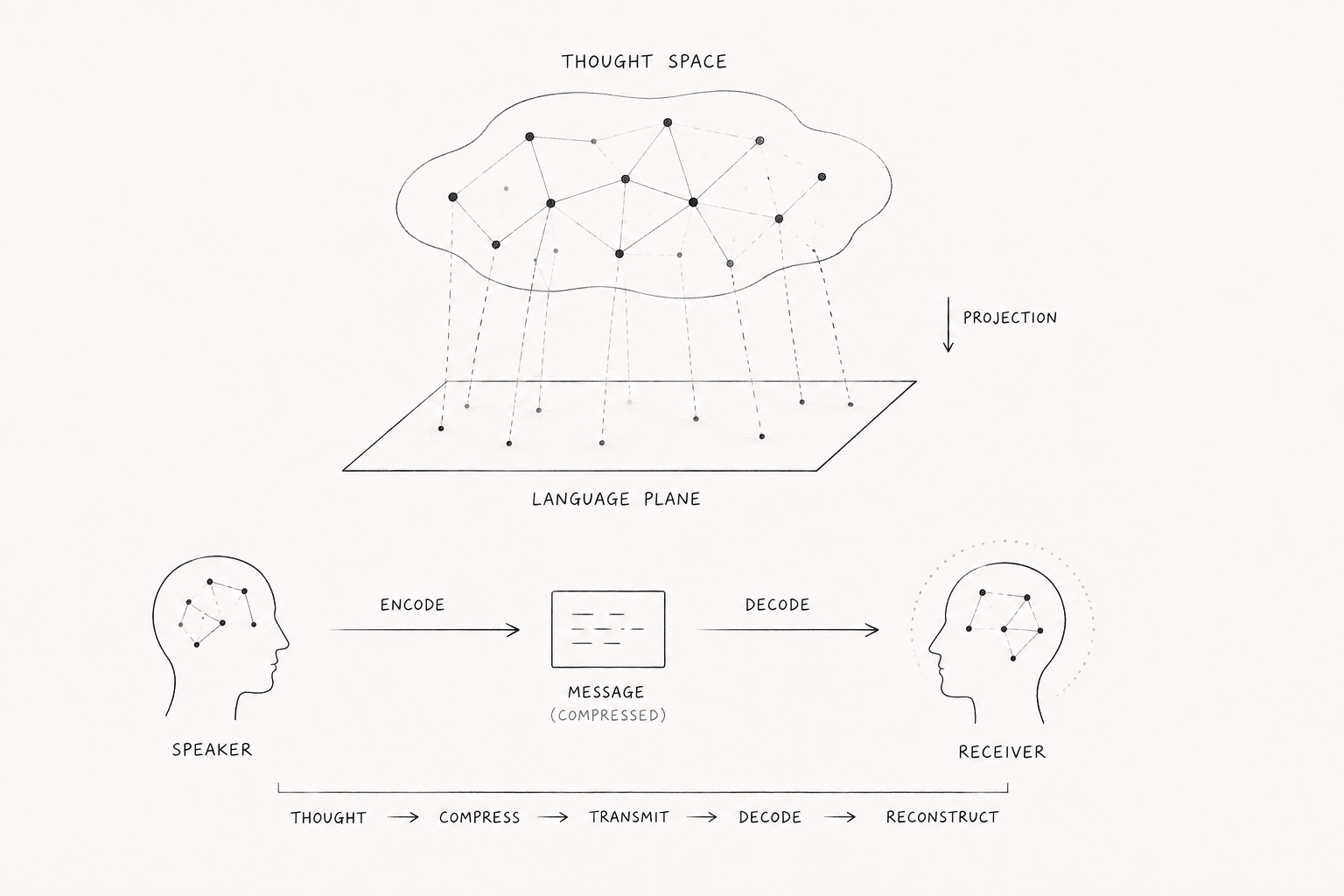
1.4. The receiver of the message does not receive the original thought. A new one is reconstructed from the compressed projection.
2. On truth
2.1. There exists an objective truth. Call it Logos, call it God, call it Tao.
2.2. This truth cannot be fully told or definitively stated in logical propositions, for those are low-dimensional properties.
2.3. Consider a starfruit. Its cross-sectional scan is absolutely precise: a shape of oval, and a shape of star. Yet a person could never understand the starfruit merely through its scan. Absolute precision on one plane equates absolute blindness to the whole.
2.4. What reveals the starfruit better is, conversely, an imprecise sketch. Using shadows and optical illusions, a less accurate but more truthful image arises. Now we can see the starfruit in 3D.
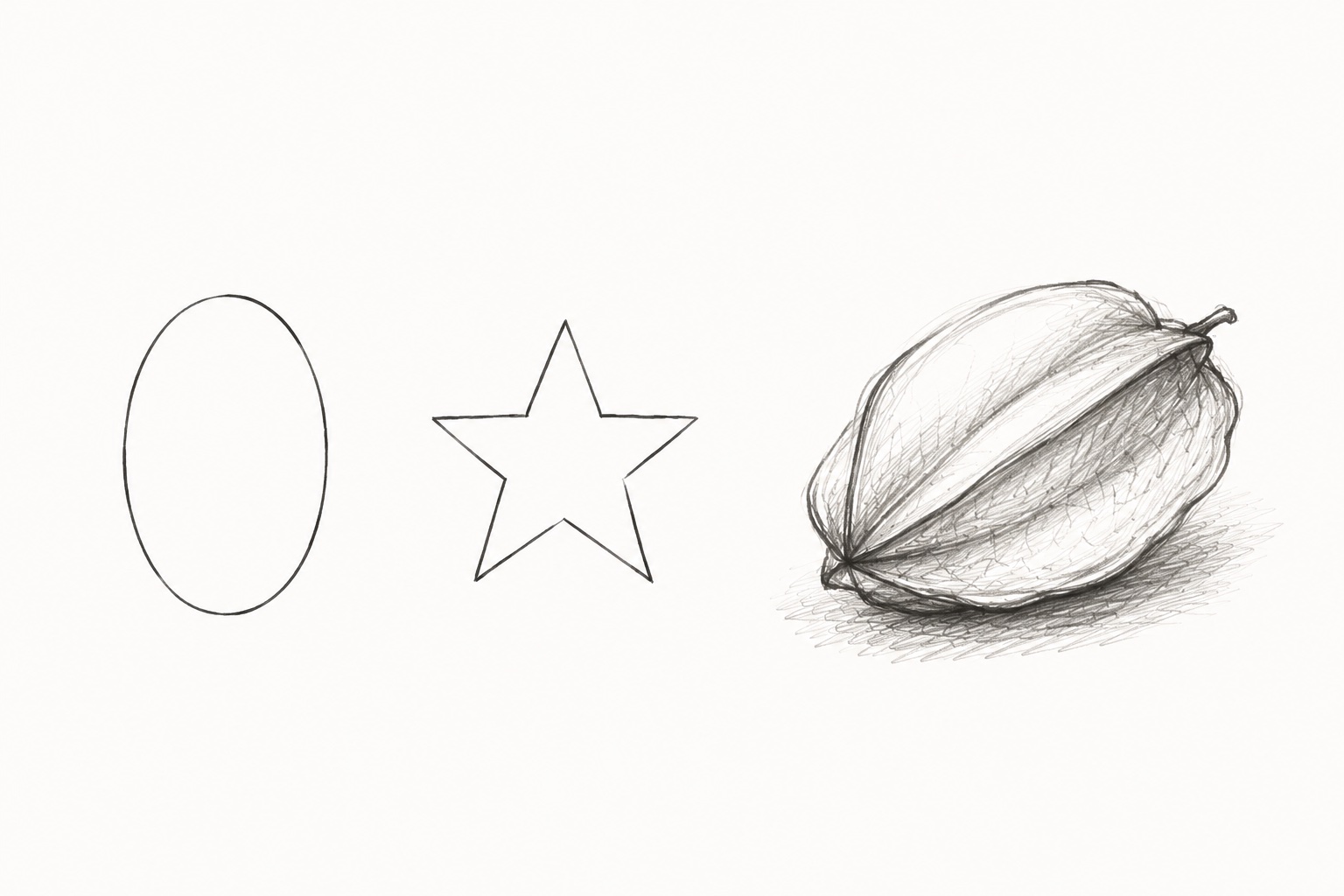
2.5. Accuracy and truthfulness are distinct properties. Accuracy is fidelity to one lower-dimensional plane. Truthfulness is fidelity to the higher-dimensional whole, achieved by deliberately imperfect means.
3. On the big questions
3.1. Hence the big questions — what is the meaning of life, what is love, are humans good or evil — could not be answered within the domain of words. Or they admit one easy answer, where the answer is "no answer."
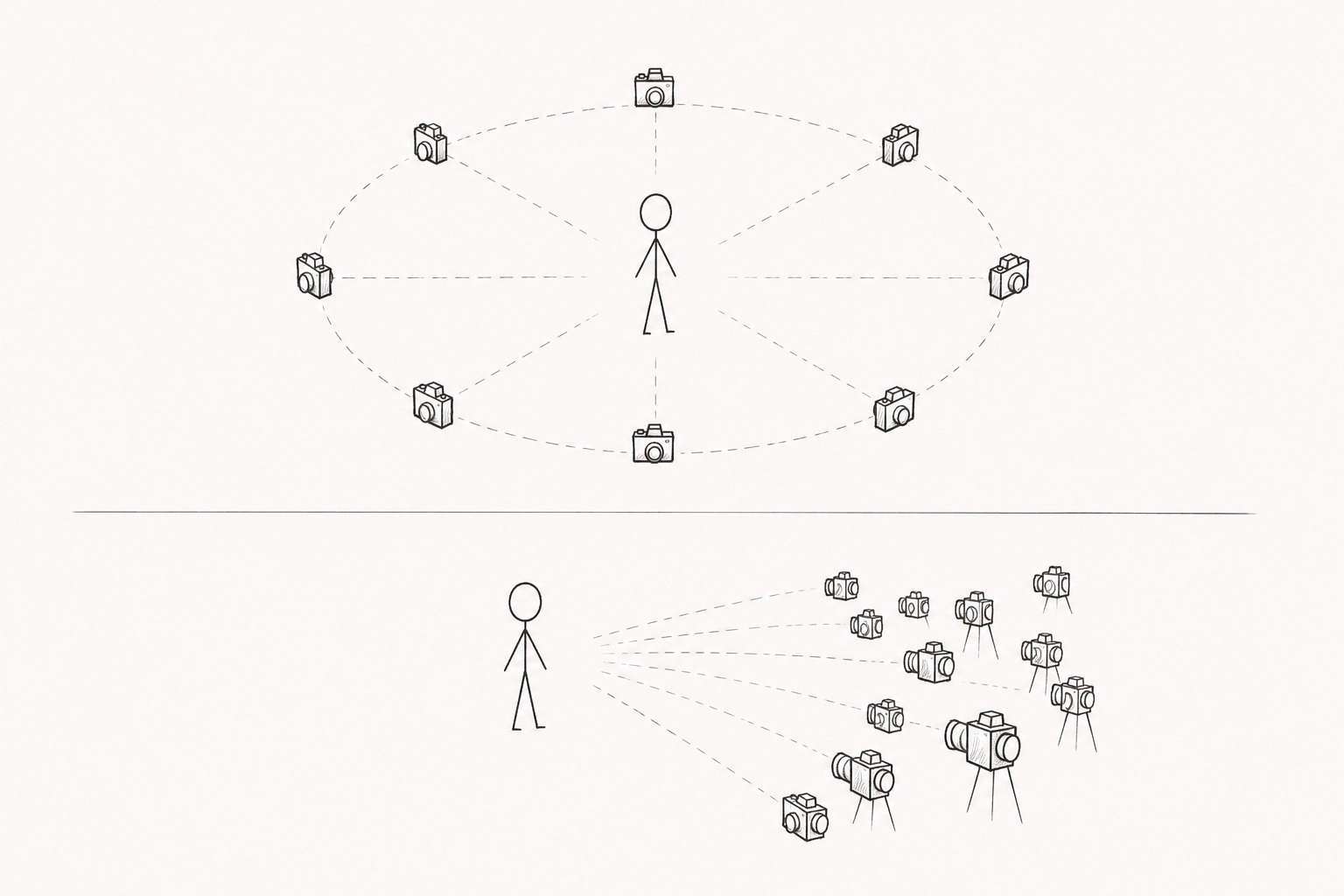
3.2. For example, say "humans are by nature good." Turn the camera to film the opposite angle, and the frame fills with evil and ugliness. It is the moment we defined which angle is considered "good", that "evil" is born. Humans are social animals who find happiness in altruism; they also carry selfish genes that put own desires before others' needs.
3.3. The contradiction is a shift in perspective captured by the camera. Good and evil exist in the body at the same time. A multi-dimensional object, photographed from two angles, yields two images that disagree but are both faithful to the truth.
3.4. Every well-known take on the big questions is by nature thought-provoking. It has to carry one compelling image that makes you feel something. Such takes are not "the truth", but well-taken pictures of the truth. They are selectively composed, optimized for clarity at the cost of completeness. For truth is always unclear and incomplete when viewed from lower dimension. To make it clear to us, the image must be compressed and cropped.
3.5. But do humans need "truth"? Is it important or beneficial at all? Nice pictures should be enough to make me happy and guide me to a good life. (See Section 6)
4. On good writing
4.1. Good writing is measured by a single criterion: how much of the full truth the flat picture can manage to restore.
4.2. A geometrical scan is mathematical, exact, and restores nothing. Writing that pursues pure logic and precision is absolutely dull and nonsensical. Add shadow, then the reader begins to see depth. Illusions, when deployed in honesty, carry more truth than pure measurements will ever do.
4.3. There are two ways to take a picture. The first way, is to gather views from many angles; this maximizes understanding, but many perspectives dilute position and produce weak opinions. The second way, is to focus on one angle and magnifies its details; this is good for clarity and persuasion, at the cost of the whole truth.
4.4. Essays and stories are chains of pictures. An essay chains images shot mostly from one angle, edited toward a claim. A story chains images from shifting angles, and declines to choose among them. The best writing has a combination of both, commits like an essay and circles like a story. Good writing waits for its spirit to emerge, a solid form that no single frame can fully contain.
4.5. There is no "view" available to us from the higher dimension. There is only better and worse paintings.
5. On thinking
5.1. Humans think all day. Call it "default setting." The mind is a camera that cannot be turned off.
5.2. No two pictures are identical, even when taken from the same camera. Each shot differs in the observer's axis, in shot angle, in zoom, in hue.
5.3. The mind is thus a generative model: it produces pictures continuously, based on whatever slice of the world is fed as prompt. Most of the pictures are discarded. The few that are kept, we call them beliefs.
5.4. The question, therefore, is never whether to take pictures, or whether it is beneficial. It is only whether the pictures you keep are good, i.e. whether they restore something of the solid, or merely trace circles.
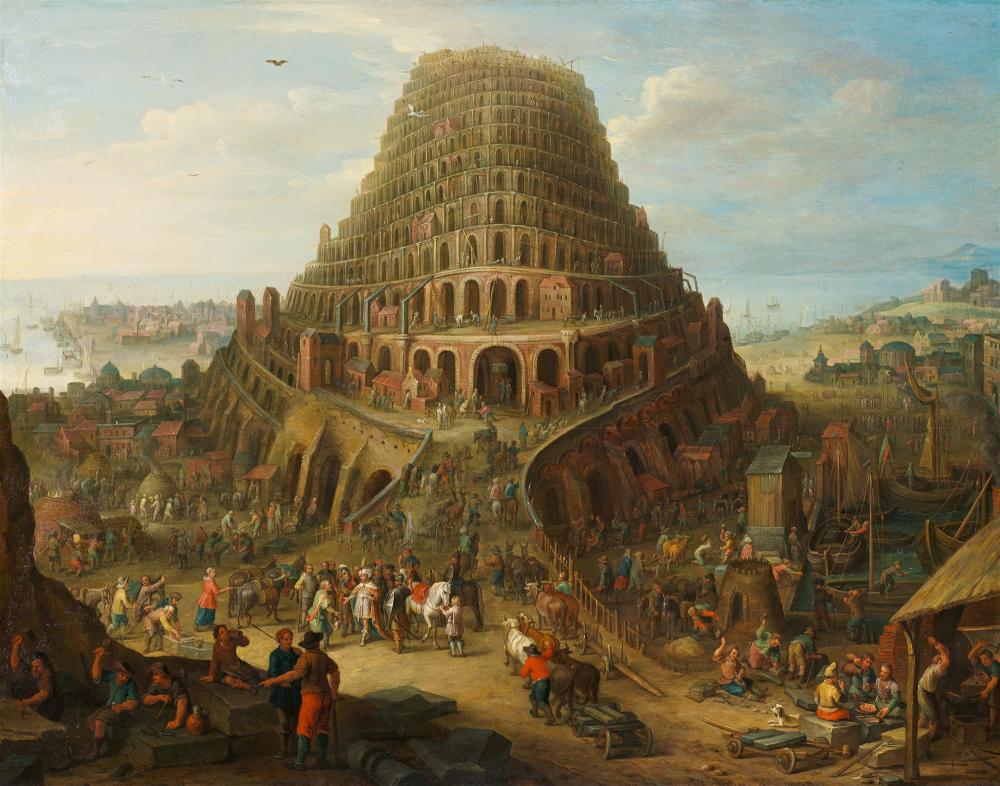
6. On the Tower of Babel
6.1. When Icarus reached for the sun, everyone knew the sun was unreachable. When the people of Babylon raised the Tower of Babel, it was already written that heaven can never be reached from earth.
6.2. Truth in its full dimension is not presentable through any communication system we can access, because it does not live on our plane. Do not think philosophers can escape this cave. They exit one cave and find themselves trapped in a bigger one. The small cave has food, dance, and warmth; the larger cave is an eternal abyss.
6.3. But do not lament how we never see truth whole; the whole is by no means nobler than its parts. If we are given wings, fly, rather than hang in the sky. If we are given bricks and stones, build a tower, rather than dream of the palace above.
6.4. Taking pictures is the pursuit of truth. Contact with truth does not lie beyond the picture; it occurs in the picture, in proportion to how well the picture is taken.
6.5. The beauty we find in literature, in mathematics, in engineering, is not the beauty of truth itself. It is the beauty of instruments invented in truth's pursuit: rulers, cameras, sketches, wings.
6.6. Admire not heaven, but the tower, the church, the house.
6.7. Admire not the truth, but its pictures. It is the pictures — to the eye, to the ear, to the brain — that bring light and music into our world, and make life worth living.
Haoji Wang
July 17, 2026